My new book club had this book assigned for discussion in October, and if this (and the Book Thief) planned for next month is anything to go by, I'm going to enjoy this every bit as much as my last group.
And The Mountains Echoed has been reviewed to death by now, so I won’t go into details on the plot, suffice to say a family is broken apart and through pure chance encounters manages to find its way back together, but not quickly and not without significant impact on all the family members. No real spoilers as I think this is fairly obvious from the start.
I’d not read anything by Hosseini before, extensive hyperbole tends to put me off a book, rather than encourage me. I did some reading about Hosseini, and his writing, and understand that this is not even considered his best work, so I’m now very tempted to move those copies of his earlier works up from where they’d been languishing at the bottom of the TBR pile.
The story scope is expansive. It ranges backwards and forwards over several decades and continents. The style is episodic, with each section having a different narrator, and their own distinct voice. Each narrator goes back to a point that their part in the overall story arc started, even if they didn’t know it, and the story follows through until their part is completed. Gradually the reader puts the pieces together, to form the whole.
All narrators have a piece of the story (except the neighbour-brother who lived in America, which wasn’t clear to me at all). They had a direct impact on events, or were necessary to pass on a message. The trick while reading is to not get distracted and try to remember all the threads so that you can sew it all together in your mind as the book moves on.
I have to admit that I was affected on many levels. The writing is wonderful, the slow drip feed of the story was enough to give the characters, time and place real depth, but still keep me reading. I ached for Pari and her brother, and felt each emotion keenly. As I mentioned before I felt that each character had their own voice, and for those in the Western world in particular, they seemed pretty authentic to me. My knowledge of Afghanistan is limited to news bulletins so I can honestly admit that I don’t know it is like to be a normal person in Afghanistan, which neatly brings me to my second point.
The Book Thief forced me to think about what life was like for ordinary Germans during WW2, and in the same way this forced me to be more aware of life in Afghanistan. To my relief it wasn’t a soapbox for a rant about the war, though the war is not avoided. The impact of the war is made clear. What is not lost in a rant is that this is a story about the intersecting lives of one family and the people they come into contact with over a number of generations. I’m a Sociologist by education, and for me it was utterly fascinating to perceive the change in culture and attitudes over time, and though I do not claim to be an expert in these matters, it seems to me that regardless of geography and religious beliefs we are all essentially the same. The overwhelming impression I now have is that below the so-called civilised surface of society we all have a commonality of existence. We all go through the same range of emotions, we all face life and death, have friendships and fall in love.
And yes, I did have a tear or two in my eyes while reading this. If this is regarded by many as not his best work, then I do really need to read the rest. I think this is really really good.
Biblio Addicted: The state of being enslaved to reading books, where it is psychologically or physically habit-forming, to such an extent that its cessation causes severe trauma.
Showing posts with label Review. Show all posts
Monday, November 10, 2014
Saturday, October 18, 2014
Review: Down the Rabbit Hole by Juan Pablo Villalobos
Last summer I had booked a spa day at Mr B's, and it just so happened that on the same day they were hosting an Author Event, so I decided to book both, and read the author's first book Down the Rabbit Hole by Juan Pablo Villalobos (JP) in preparation. Mostly so I would have some clue as to what he's talking about... I figured if I didn't enjoy it I could always cancel going to the author event. I thought it was great and got really excited about attending the session. So anyway, here's a bit more about the book. Article about the event to follow.
I thought it was a brilliant little book, a novella rather than a novel, but a great read. I've borrowed the blurb from Goodreads, as I couldn't possibly have described it better:
The black humour serves as a device to drive home the point that Tochtli's world is vile and corrupt. His innocence, and acceptance of terrible violence as normal serves to highlight the horror of the world he lives in, and JP achieves this spectacularly well.
Tochtli's exposure to the world is extremely limited. He reads dictionaries and while he uses the terms literally his favourite words are awful.
The book is sensational in my opinion, and leaves a mark. I don't think I will ever forget reading it.
I thought it was a brilliant little book, a novella rather than a novel, but a great read. I've borrowed the blurb from Goodreads, as I couldn't possibly have described it better:
Tochtli lives in a palace. He loves hats, samurai, guillotines and dictionaries, and what he wants more than anything right now is a new pet for his private zoo: a pygmy hippopotamus from Liberia. But Tochtli is a child whose father is a drug baron on the verge of taking over a powerful cartel, and Tochtli is growing up in a luxury hideout that he shares with hit men, prostitutes, dealers, servants and the odd corrupt politician or two.I've never read anything that left me feeling so uncomfortable, but which I think is so completely excellent. It is a masterpiece of writing that can entertain (there's a lot of black humour) and deeply disturb you at the same time. I am not a writer, as you can plainly tell reading this, so I'm afraid I don't have the right words to express what this book made me feel.
The black humour serves as a device to drive home the point that Tochtli's world is vile and corrupt. His innocence, and acceptance of terrible violence as normal serves to highlight the horror of the world he lives in, and JP achieves this spectacularly well.
“It's like a competition: the one who wears the crown is the one who's made the most corpses.”Corpses are so commonplace and normal to Tochtli that you feel these words are delivered in the same way that people might say 'Dead bodies are just so last week'. Corpses are just no big deal. Fodder for pet lions and nothing more.
Tochtli's exposure to the world is extremely limited. He reads dictionaries and while he uses the terms literally his favourite words are awful.
The book is sensational in my opinion, and leaves a mark. I don't think I will ever forget reading it.
Tuesday, October 14, 2014
Death and the Penguin - Andrey Kurkov
At my third book spa a few months ago I was presented with
Death and the Penguin. I had previously
rejected it (wasn't in the mood for bleak Russian drama), but I figured if
it had been selected in two out of my three book spa’s then I may as well
have done with it and give it a try.
Despite what turned out to be a fairly accurate description I wasn't
quite sure what to expect from this book.
It’s set in Kiev, Ukraine, and tells the story of how Viktor
and his pet King Penguin Misha become caught up in the middle of a mafia
war. A frustrated writer Viktor finds a
job at a newspaper writing obituary articles for the famous and infamous of
Kiev who haven’t died yet. At first able
to pick and choose who he writes about nobody seems to be dying, after a while
the first death happens, and the Editor starts sending lists and bio’s for
people he wants articles for. Viktor’s
life becomes increasingly complicated and dangerous until the rather surprising
(to me) ending. Throughout there is a
tone of melancholy. Viktor is a man to
whom life happens. He doesn't ever seem
to feel he has a choice, or control over events. He also has a strong sense of not being able
to form good relationships with people, or Misha, and he and the story are a
little frustrating at times. I just
wanted to grab him and shake some life into him. In actuality Viktor is the personification of
the general feeling of decline of Kiev described in the book. Powerless people just trying to earn what
little money when and where they can and stay alive.
It sounds bleak and terrible, and yet it’s not. The book has comedic moments, and you do just
have to keep reading. I had to keep
reading to see if Viktor realised what his articles were being used for, and
why. I had to see what happened to him, Misha
the Penguin, and the few people that Viktor acquires along the way. I will definitely be reading ‘Penguin Lost’,
the sequel.
When I was reading up about the book I found this article onThe Guardian website, where it appears that the story was rather
prophetic. First published in Russian in
1996, it was around the time of it’s publication in English in 2001 that real life events
appeared to be imitating the book. For an audience like me, who is not all that aware of what life in the Ukraine is really like it set things in a whole new uncomfortable light.
Well worth a read in my opinion.
Friday, October 10, 2014
Review: The Wise Man’s Fear by Patrick Rothfuss
The Wise Man’s Fear by Patrick Rothfuss is book two in the Kingkiller Chronicle trilogy, and having thoroughly enjoyed book one I couldn’t wait to get my hands on this instalment.
In summary, Excellent storytelling (Rothfuss could make the phonebook a pleasure to read), and so many good and wonderful things about it, and only one little annoyance.
I’ve mentioned in another review for a book in a totally different genre, that having a main protagonist who is miraculously good at everything is not a good thing. Kvothe barely pauses before finding the right way of dealing with any given challenge. Escape from Pirates? Discover a murder plot? Cure a fatal illness? Create life-saving charms and gadgets? Woo a lady for a pseudo-King? Learn a few new languages? Dispatch multiple bandits, kidnappers and rapists? No problem! All in an afternoon’s work for our Kvothe!
That’s not to say that I didn’t enjoy the book immensely! As I alluded earlier Rothfuss knows how to write, he really does. This is epic storytelling, but on an intimate scale, what I mean by that is that the scope is large, and the story roams all over, but it is recalled in minute detail. For me this meant that I had the feeling of living the story myself. No detail seems too small or too insignificant, and it makes Kvothe’s world so rich and real that you could be walking the Archives, playing the lute, or running across rooftops right along with him. The other side of this is that the books have to be suitably large to be able to cram all this in! Purportedly 390,000 words over 994 pages for just the second book in the series! By the end of the trilogy I’ll have read over 1 million words (not including the two novellas).
Didn’t like: Perfect Kvothe, all hail Kvothe! There are a few plot threads that seem to go nowhere. I’m prepared to forgive Rothfuss because his writing is so enthralling, and I just hope that those plot threads tie up in book three.
Did like: Everything else!
PS: Though Kvothe manages to get through an awful lot in this book, there are events that have to be sacrificed. I think I would have loved to see what happened when Kvothe sailed to Severen. If it had meant a Quadrilogy instead of a Trilogy I’d be happy with that. Or maybe I sense another Novella to come…
PPS – In my review of The Name Of The Wind I said I would share my theories of Chronicler… so here they are.
Chronicler:
May be more than who and what he claims to be. Something in the back of mind is telling me this has to be the case, especiallly given Rothfuss’ inclination towards complicated plots.
May be one of the Amyr, recording the story only to alter/cover up their continued existence (by the end of this book their existence is theoretical, no spoilers here).
May be one of the Chandrian, reluctant to engage Kvothe in Battle but needing to assess his next move/intentions. Doubtful as I think by the end of book three the Chandrian will probably be no more. Also, I don't think they are inclined to hold off on an attack.
In summary, Excellent storytelling (Rothfuss could make the phonebook a pleasure to read), and so many good and wonderful things about it, and only one little annoyance.
I’ve mentioned in another review for a book in a totally different genre, that having a main protagonist who is miraculously good at everything is not a good thing. Kvothe barely pauses before finding the right way of dealing with any given challenge. Escape from Pirates? Discover a murder plot? Cure a fatal illness? Create life-saving charms and gadgets? Woo a lady for a pseudo-King? Learn a few new languages? Dispatch multiple bandits, kidnappers and rapists? No problem! All in an afternoon’s work for our Kvothe!
That’s not to say that I didn’t enjoy the book immensely! As I alluded earlier Rothfuss knows how to write, he really does. This is epic storytelling, but on an intimate scale, what I mean by that is that the scope is large, and the story roams all over, but it is recalled in minute detail. For me this meant that I had the feeling of living the story myself. No detail seems too small or too insignificant, and it makes Kvothe’s world so rich and real that you could be walking the Archives, playing the lute, or running across rooftops right along with him. The other side of this is that the books have to be suitably large to be able to cram all this in! Purportedly 390,000 words over 994 pages for just the second book in the series! By the end of the trilogy I’ll have read over 1 million words (not including the two novellas).
Didn’t like: Perfect Kvothe, all hail Kvothe! There are a few plot threads that seem to go nowhere. I’m prepared to forgive Rothfuss because his writing is so enthralling, and I just hope that those plot threads tie up in book three.
Did like: Everything else!
PS: Though Kvothe manages to get through an awful lot in this book, there are events that have to be sacrificed. I think I would have loved to see what happened when Kvothe sailed to Severen. If it had meant a Quadrilogy instead of a Trilogy I’d be happy with that. Or maybe I sense another Novella to come…
PPS – In my review of The Name Of The Wind I said I would share my theories of Chronicler… so here they are.
Chronicler:
May be more than who and what he claims to be. Something in the back of mind is telling me this has to be the case, especiallly given Rothfuss’ inclination towards complicated plots.
May be one of the Amyr, recording the story only to alter/cover up their continued existence (by the end of this book their existence is theoretical, no spoilers here).
May be one of the Chandrian, reluctant to engage Kvothe in Battle but needing to assess his next move/intentions. Doubtful as I think by the end of book three the Chandrian will probably be no more. Also, I don't think they are inclined to hold off on an attack.
Monday, October 6, 2014
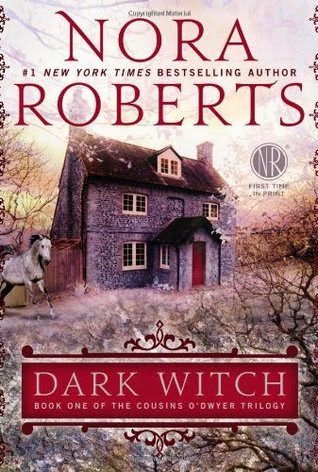
Review: Dark Witch by Nora Roberts
When I heard that Nora Roberts was releasing a new Supernatural trilogy I couldn't wait. But I did, I forced myself to wait for months. I bought Dark Witch, and then Shadow Spell, and by the end of this month Blood Magick will be out. Normally when a series is announced I pre-order each book as soon as I can, and start reading it the moment I unwrap the package. Then I wait and wait and wait for the next one.
This time I decided that I would save them up, so I didn't have that torturous wait between instalments, As the final book in the trilogy will be out shortly I decided that it was safe to start book one.
I try to only write reviews about books I really like... But this was on my mind, and I felt like I had to write this. I'm sorry to say that this one left me a little cold. I gave it three out of five stars on Goodreads. It's OK, but it's not up to normal standard.
It started out well, and then disintegrated. Here's why:
And finally... The turn of phrase used by ALL characters is EXACTLY the same. This REALLY got on my nerves. It doesn't seem to matter if you're a 13th Century Irish witch, her young children, an early 21st Century American in Ireland, or her two Irish born and bred cousins or their friends. Even gender and age don't change the way they speak. Everybody gets the same voice. Even so far as I felt like I was reading one of the 'In Death' books. It made me wonder if Ms Roberts jumped straight from writing for Eve Dallas, mid-21st century New York City cop to writing for Sorcha, 13th century Irish witch, without as much as stopping for a cup of tea (or coffee).
It would have been nice if each character had more of a distinct voice, especially where geography and cultural upbringing vary so wildly. My sister and I are reasonably close in age, grew up in the same house, with the same parents, went to the same schools, and yet we have totally different voices. It would have been nice to see some variation in characterisation.
I am now part way through book two in the series (Shadow Spell) and it's the same, though on a positive note there is some better characterisation of the leads in this one.
This time I decided that I would save them up, so I didn't have that torturous wait between instalments, As the final book in the trilogy will be out shortly I decided that it was safe to start book one.
I try to only write reviews about books I really like... But this was on my mind, and I felt like I had to write this. I'm sorry to say that this one left me a little cold. I gave it three out of five stars on Goodreads. It's OK, but it's not up to normal standard.
It started out well, and then disintegrated. Here's why:
- I loved Sorcha, she had power, strength of character, deep feelings and was fairly rounded out character for all that she's only in it a short while.
- I kind of like the characters, at least what you see of them, they're pretty one-dimensional.
- Iona (the female romantic lead) has no internal thoughts. Every little thing gets blurted out, and every other sentence contains 'Sorry'. Seriously, it was verging on the ridiculousness of Fifty Shades.
- Boyle (the mail romantic lead) has no personality. Whatsoever. Iona's horse has more personality!
And finally... The turn of phrase used by ALL characters is EXACTLY the same. This REALLY got on my nerves. It doesn't seem to matter if you're a 13th Century Irish witch, her young children, an early 21st Century American in Ireland, or her two Irish born and bred cousins or their friends. Even gender and age don't change the way they speak. Everybody gets the same voice. Even so far as I felt like I was reading one of the 'In Death' books. It made me wonder if Ms Roberts jumped straight from writing for Eve Dallas, mid-21st century New York City cop to writing for Sorcha, 13th century Irish witch, without as much as stopping for a cup of tea (or coffee).
It would have been nice if each character had more of a distinct voice, especially where geography and cultural upbringing vary so wildly. My sister and I are reasonably close in age, grew up in the same house, with the same parents, went to the same schools, and yet we have totally different voices. It would have been nice to see some variation in characterisation.
I am now part way through book two in the series (Shadow Spell) and it's the same, though on a positive note there is some better characterisation of the leads in this one.
Thursday, October 2, 2014
Review: The Name of the Wind by Patrick Rothfuss
The Name of the Wind is a debut novel from Patrick Rothfuss, and is the first instalment of The Kingkiller Chronicle trilogy. It begins in the Inn belonging to a man called Kote who by means of killing a spider with razor sharp feet establishes himself as a worthy fighter. A Chronicler recognises Kote as Kvothe, a character of legendary proportions and proceeds to take down his story. Each day that it takes to record Kvothe’s life story is to be one book in the trilogy.
Kvothe has a rough start in life. He’s born into an apparently idyllic life as the son of a travelling troupe leader, and is remarkably clever and talented. Early in life he meets an arcanist (like a magician) who inspires him to attend the University and learn the secrets of magic, such as the true names of all things, particularly the wind. Then one night his family and fellow troupers are brutally slain and Kvothe is lucky to be alive. He struggles to survive a callous world and eventually manages through perseverance and sheer luck to make his way to the University, this time to discover the identity of the men who killed his family so he can take his revenge.
For a genius Kvothe is also a bit of a bumbling idiot, stumbling his way through life, hanging on by the skin of his teeth. Once he reaches the University he usually ends up making his own troubles, and has to struggle to keep going, and this forms the bulk of book one. I couldn’t wait to turn the page to find out how Kvothe’s enemies might challenge him, or see him retaliate only to end up in a worse situation than ever. Some of his exploits had me laughing out loud, and it was pretty compelling reading. This was the books charm and Kvothe makes quite an endearing character in spite of his numerous serious flaws. I ended up really liking him and rooting for him.
I seriously have a contender now to challenge Scott Lynch and Locke Lamora for the position of favourite fantasy novel. I highly recommend The Name of the Wind by Patrick Rothfuss. It’s a monster of a book, but the time flies by so fast. The writing is engaging and I couldn’t bear to put it down.
I hope you try it, and I hope you love it as much as I did.
PS – I have a few theories about Chronicler… will share them in the upcoming review of Book 2: The Wise Man’s Fear.
Friday, November 15, 2013
Review: Daughter of Smoke and Bone by Laini Taylor
Publisher: Hodder
ISBN: 1444722654
Since I’ve been
blogging (almost a year now) I have seen this book appear on Top Ten Tuesday
lists nearly every week. It seems to
score highly for plot, genre, author, characters and even ‘Best books ever’
type lists. So when it was suggested
during my September book spa at Mr B’s bookshop in Bath I knew I had to read
it.
It turned out better
than expected, and I cannot recommend it highly enough!!!!
Short
Synopsis: Karou is a 17 year
old art student in Prague. She is far
from ordinary, she has blue hair and wears a string of wishes around her neck. She lives a double life, one foot in Prague
and one in a shop ran by the only father figure she has ever known. She doesn’t
know who her parents are, and the only family she knows are magical creatures
unable to walk in our world. She spends
her days dodging her ex-boyfriend, attending art classes and collecting teeth. Until on one of her errands she is attacked
by an angel. That’s when then things
start to get interesting.
I could wax lyrical
about this book using all the superlatives in my repertoire, but I will try to
keep it brief.
The plot –
fascinating, original, complicated and will keep you guessing
The characters –
multifaceted, intriguing, lovable, frustrating, hateful, you name it.
The settings – this and
the other world are well described and I had no problem imagining myself in
Prague or the other realm.
The writing –
inspired. I practically inhaled the
book! I could not put it down.
What
I liked most: Everything! I can’t wait to get my hands on the next in
the series. I just have to read what is
on my shelves first, which is painful, as Days of Blood and Starlight is all I
want to read right now.
What
I liked least: That I have to wait before I can get a
copy of the sequel.
Thursday, November 14, 2013
Review: Whispers Under Ground by Ben Aaronovitch
Format: Kindle
This series just
keeps getting better and better!
Short
Synopsis: An American student,
the son of a politically powerful family is found murdered near Baker Street
station. It soon becomes clear that the
death has some special characteristics suitable for the Folly’s involvement. PC Peter Grant is called in to investigate
the magical goings on, and forced to work with an FBI agent, crawling through
the London sewers on the trail of mysterious creatures.
Each book does get
better and better, as Peter Grant’s world is built upon each time. The plots are consistently engaging and it
feels not so much a genre of magical realism or urban fantasy as police
procedural. Magic is presented as just a
part of PC Grant’s job. Secondary
characters are not forgotten and are allowed to grow and develop too. I love every little titbit we find out about
Molly. I sincerely hope we learn her secrets
and background one day!
What
I liked most: Pretty much everything! Characters developing well, we learn more
about magic along with Peter and the stories are totally original and new every
time.
What
I liked least: It’s been a while since I read this, so
it’s hard to look back and recall the things I didn’t like. The only possible negative is that it took a
while to put all the pieces together before we could get to the denouement. But
then again that could be me being impatient.
Monday, November 11, 2013
Review: The Daylight Gate by Jeanette Winterson
Publisher: Hammer
ISBN: 0099561832
I don’t think I’ve ever been so productive on the blog as I have with
this Challenge…
I recently read this as a book club selected read for
October. Helen from Fennell Books liked
it as did I think everyone else to some degree.
I didn’t hate it, but I’m not a fan either.
Short Synopsis: Based on the first set of well documented court
records of the Pendle/Lancaster Witch Trials of 1612 it follows Alice Nutter
through the recorded events up to, and a little beyond, the end of the court
hearings. There is some artistic licence
is used to add detail and backstory etc…
As I mentioned earlier I didn’t hate it, but I can’t say that
I enjoyed it either. You know how
sometimes there’s nothing really wrong with a book, but it just doesn’t gel
well for you? No particular reason, it
just doesn’t suit? I’m afraid this was
the case for me with The Daylight Gate.
Maybe it was because it was based on true events. I did spend most of the book thinking about
what was real and what was not. Some of
it was clear, other parts were not, so I was rather distracted by that
throughout. Maybe it depends on whether
you think witchcraft is real. I don’t, so much of the book dealing with the
supernatural aspects I found totally unbelievable. I personally didn't care for any of the
characters. I thought that the treatment
of women in general, and Jennet Device in particular while utterly believable, was
also utterly sickening. This is probably
the best part of the story, in terms of getting me invested in what was
happening. The ending was brilliant!
There were some excellent moments, and if you like
historical fiction you might well enjoy this.
According to members of the book club this will be made into
a film by Hammer as well.
Saturday, November 9, 2013
Review: The Light Between Oceans by ML Stedman
I’d heard so many good things about this novel, and I really
love a book that makes me feel something, so when this was on a multi-buy offer
at Smiths I couldn’t resist. Nor could I
leave it sitting on the shelf for ages waiting for me to pick it up.
It’s one of those rare books too that had me thinking about
it when I couldn’t read it. Great for my
reading experience, very bad for working life!
Short Synopsis: Tom
is a soldier returned from WW1 to live off the coast of Western Australia where
he is a lighthouse keeper. He marries Isabel
and they’re madly in love and desperately sad that they haven’t been able to
have children, so when a rowing boat containing a baby and a man’s body wash up
on the shores of the lighthouse they make a decision that will change many
lives forever.
The story is wonderfully written and draws you into Tom and Isabel’s
world until you feel what they feel.
When they struggle with the decisions they’ve made I felt for each of
them, and when faced with harder and harder choices my heart just ached. The ending was beautifully handled and you
will need a book of tissues close to hand.
What I liked most: The setting, the emotional drama, the
characterisation.
What I liked least: There were a couple of moments that I
felt the story could have moved a little faster, but that might be my
impatience to resolve the pain everyone is going through.
Wednesday, November 6, 2013
Review: Nightfall by Isaac Asmiov and Robert Silverberg
November challenge continues apace...
Publisher: Doubleday
Format: Hardback
Source: Library
This was a treasured read from many years ago, so when I managed
to get agreement to put a Sci-Fi book onto the reading list at Book Club this
was the one I had to suggest. It’s
easily accessible to readers new to SF, and is based on Asimov’s 1941 original
short story, one of the best examples of SF ever written.
Short Synopsis: Kalgash
is a planet with 6 suns. It’s stellar
orbit lasts a little over 2000 years and it is never completely in the dark. The story starts with three apparently
separate threads which converge together about half way through the novel. There is a psychologist studying the effects
of a new theme park ride through a dark tunnel; an archaeologist survives a
sandstorm which reveals evidence of multiple
layers of past civilisations and their regular destruction; and a scientist
realises that the standard calculation of the stellar orbit of Kalgash isn’t
quite right. You can probably surmise what
happens when all three threads finally meet.
Though the 1941 short story is highly praised, unfortunately
the version expanded on by Robert Silverberg was not so well received. Asimov’s short story has its major impact in
its brevity, having to be faster paced and punchier. However I think the novel expands in areas I
felt lacking in the shorter version. It’s
not perfect by any means, but I thoroughly enjoyed it. The themes of science vs religion, the
exploration of fear of the unknown and our relative smallness in the universe were
well portrayed and despite its alien world setting, it is highly transferable
to our own society.
The response from the book club was mixed, which can be hard
to take when you love the book that some people just didn’t get. It was well received by some but those that
turned up tended towards mockery of the plot and the science. I suppose we have the benefit of 21st
century knowledge over the original 70+ year old story, and the parts that were
pulled apart were the parts expanded upon by Silverberg. Asimov’s concepts were acknowledged as very
good though, which I suppose is something :-)
I read this for the first time not long after publication of
the extended novel, about 20 years ago, and it endured with me for one
particular scene. The scene describes
the astronomer Beenay handing out cameras to his team instructing them to
photograph the stars. He instructs them
not to waste time trying to get more than a few stars in each photo. Of course when the darkness finally comes the
sheer number of stars is overwhelming, and the ridiculous notion of there only
being a handful of stars is realised.
I was lucky enough once to be in the Australian outback at
night, and though I had seen photos of a full-on starry sky, it still didn’t
prepare me for the spectacle that is the Milky Way. It brought back the memory of that moment in
the book where they begin to realise the magnitude of the universe. Now every time I look at a starry sky that
moment pops into my head. I imagine that
will be with me for the rest of my days.
So, Nightfall has it’s pitfalls, but it’s still
an entertaining read overall. I would
certainly read the short story version at least! It is available on the internet and I think
you can download it free of charge from a number of sources.
Sunday, November 3, 2013
Review: The Book of Dead Days by Marcus Sedgwick
My November challenge is hotting up …
Thanks to Mr and Mrs F from Fennell Books for this
recommendation!
Have you ever considered the days between Christmas and New
Year? Those days when the excitement and
hustle and bustle of Christmas has passed and New Year has not yet arrived? According to Marcus Sedgwick’s book these are
dead days, the days between two major events where not much happens
normally.
For us these days are ones where the movies are reruns we’ve
seen many times before, our presents are put away, possibly broken, batteries
confiscated by irate parents. They are
the days of the end of year sales, where you’ve taken back that too big jumper,
or packed up that fugly ornament for the charity shop.
Not so for our young hero Boy and his new BFF Willow. They are attempting to save the life of Boy’s
master, Valerian, who is due to die at midnight on New Years Eve. You see he made a Faustian deal, and the deal
is almost at its end. Their quest is to
find a mysterious book that contains the secret to saving Valerian’s life,
during which they find themselves wanted as suspects in two murders, running
across country and through the underground catacombs and rivers of the city.
To tell you any more would be to ruin the story. The writing is suspenseful, and the plot and
characters engaging, and I thoroughly enjoyed it. The Book of Dead Days is followed by The Dark
Flight Down, and if I am understanding it right there will be no further books,
which makes a refreshing change to all those long long series!
Friday, November 1, 2013
Review: The Greenwitch by Susan Cooper
My November challenge to catch up with posting my reviews has
now started, and here is the first of many (well, quite a few) to come this month…
Publisher: The Folio Society
The Greenwitch is the third book in the Dark is Rising
sequence, and sees the welcome return of Simon, Jane and Barney who originally featured
in the first book Over Sea Under Stone.
In this story the children are joined by their Uncle Merry again, along
with Will Stanton from the second book ‘The Dark is Rising’. Will appears to have grown into his role as
an Old One, and it’s good to see all our heroes allied in the continuing battle
between Light and Dark.
The Greenwitch of the title is a large humanoid sculpture woven
in wood, built by the women of the village, to take part in an ancient local
tradition. It was built to be thrown
into the sea as an offering to ensure the safety of the fisherman of the
village. It represents the oldest of
magic, a neutral magic not concerned with either light or dark. The story is at last a chance for the women
of the town, and particularly Jane, to shine.
It feels like a continuation of the first story, with Will Stanton
as an added extra, and it picks up where the last left off. In the first book during the search for the
grail an important piece was lost to the sea, and this story concerns itself
with the recovery of the lost piece of the puzzle. The piece is being guarded by the Greenwitch
who does not want to lose her prize.
For me this was the weakest of the books so far. It was still well written, there was some sense
of threat at times, but I felt that it didn’t have the thrill of the first
book, or the depth of the second. Well
worth reading nonetheless! I have heard
really good things about the rest of the series, and they are on the shelf
ready to go.
Friday, October 4, 2013
Review: Of Mice and Men by John Steinbeck
Publisher: Penguin Modern Classics
ISBN: 9780141185101
This has probably been reviewed to death over the last few decades, so I'll try not to show myself up too much...
Regular readers of my blog will know that I have an issue with 'the classics', even the modern classics. Bad school experiences of reading classics and years of being put down by teachers and peers meant I didn't think I could handle them. At my school we never studied Of Mice and Men. I remember Romeo and Juliet (which I hated then and now) but I don't remember much else, except we didn't read this book. I really wish we had. I loved it.
For those who might this story, here's the short synopsis: George and Lennie are itinerant workers, moving from farm to farm in 1930's California. They dream of one day owning their own farm, but they never stay long enough anywhere to be paid enough to save up the money needed to buy a place. George wants to work his own land and have the security and stability of staying in one place, whereas Lennie just wants to keep pet rabbits that he can stroke. George is sharp-witted, and a protector to his friend Lennie, who is a giant of a man, as dim and strong as he is tall. Unfortunately for Lennie, he has a tendency toward unintentional violence when panicked and his strength means he can be very dangerous. George and Lennie find themselves jobs on a new farm where the prospects of owning their own farm begin to improve. The wife of the farm manager provokes Lennie and things come to a head. Suddenly their dream becomes impossible and George and Lennie's friendship is tested to the extreme.
I did read the introduction to the book, which may have helped, but I found Steinbeck a master of scene setting and characterisation, so it didn't matter that I'm not American, and I haven't studied American history. The book is very short but nonetheless he created George and Lennie's world very convincingly, and made them totally real for me.
There are a number of themes running through the book... Racism, 1930's California farm setting, Poverty, Death, but the strongest theme for me was Friendship. George and Lennie are chalk and cheese, but there's no splitting them up. I think of Friendship as almost having a scale, with friends that are like family at one end, and deadly enemies at the other. The scale is fluid and flexible, and this story touches every part of that scale. It pushes and flexes and tests every point until the final scene, which utterly broke my heart.
I am definitely going to be reading more of Steinbeck's work, and I couldn't be happier to have made another step into the 'classics'.
ISBN: 9780141185101
This has probably been reviewed to death over the last few decades, so I'll try not to show myself up too much...
Regular readers of my blog will know that I have an issue with 'the classics', even the modern classics. Bad school experiences of reading classics and years of being put down by teachers and peers meant I didn't think I could handle them. At my school we never studied Of Mice and Men. I remember Romeo and Juliet (which I hated then and now) but I don't remember much else, except we didn't read this book. I really wish we had. I loved it.
For those who might this story, here's the short synopsis: George and Lennie are itinerant workers, moving from farm to farm in 1930's California. They dream of one day owning their own farm, but they never stay long enough anywhere to be paid enough to save up the money needed to buy a place. George wants to work his own land and have the security and stability of staying in one place, whereas Lennie just wants to keep pet rabbits that he can stroke. George is sharp-witted, and a protector to his friend Lennie, who is a giant of a man, as dim and strong as he is tall. Unfortunately for Lennie, he has a tendency toward unintentional violence when panicked and his strength means he can be very dangerous. George and Lennie find themselves jobs on a new farm where the prospects of owning their own farm begin to improve. The wife of the farm manager provokes Lennie and things come to a head. Suddenly their dream becomes impossible and George and Lennie's friendship is tested to the extreme.
I did read the introduction to the book, which may have helped, but I found Steinbeck a master of scene setting and characterisation, so it didn't matter that I'm not American, and I haven't studied American history. The book is very short but nonetheless he created George and Lennie's world very convincingly, and made them totally real for me.
There are a number of themes running through the book... Racism, 1930's California farm setting, Poverty, Death, but the strongest theme for me was Friendship. George and Lennie are chalk and cheese, but there's no splitting them up. I think of Friendship as almost having a scale, with friends that are like family at one end, and deadly enemies at the other. The scale is fluid and flexible, and this story touches every part of that scale. It pushes and flexes and tests every point until the final scene, which utterly broke my heart.
I am definitely going to be reading more of Steinbeck's work, and I couldn't be happier to have made another step into the 'classics'.
Saturday, September 14, 2013
Review: The Girl Who Circumnavigated Fairyland... by Catherynne M. Valente
Publisher: Constable and Robinson
ISBN: 978-1780339818
Apologies for shortening the title, it's a bit long for the post title... Here it is in full:
the GIRL who CIRCUMNAVIGATED FAIRYLAND in a ship of her own making
This is in serious contention for my favourite book of 2013! You might be able to tell given that this is
the longest review I’ve ever written.
Sublime, Charming, Whimsical, Magical, Utterly Brilliant, a work
of Genius. It is light and funny as well
as dark and upsetting. Everything a
fairy tale should be! The cover of the
book I have has a quote from Neil Gaiman who calls it ‘Glorious’. I’m not going to be the one to argue with a
giant of storytelling like Gaiman. Every
superlative is well deserved. I think in
years to come this will be a classic and a must read. I don’t know why this doesn’t have more
attention, as I’m writing this there are only 36 reviews on the Amazon UK site!
Short Synopsis: Set during one of the World Wars, September
is a Nebraskan 12 year old somewhat heartless girl whose Father is away
fighting in Europe and Mother is busy working towards the war effort. She feels rather abandoned by them and so
when a Green Wind comes along and offers to take her to Fairyland she climbs
onto his Leopard of Little Breezes and flies away, without even saying
Goodbye. Even getting into Fairyland is
an adventure. Once inside she embarks on
a quest that has her crossing and then circumnavigating Fairyland. She meets incredible characters, all of whom
are well drawn and fully developed, even if they are only on a few pages.
It’s blindingly obvious to any reader that Valente has
written a brilliant book here. In the
best tradition of fairy tales this has humour, love, friendship, violence,
death, good, evil, personal sacrifice, and a little lesson to be learned. This lesson being that the good and the bad
exist in all of us, and nobody is as simple as they seem. Our heroine is pretty kick-ass and brave, but
she is not perfect, other characters have also been given such dual natures,
meaning that each is as complex and diverse as any I’ve read anywhere. Put simply - Valente’s characterisation is
phenomenal.
The secondary characters, as I’ve said are complex and form
strong bonds with September and the reader.
I loved A-through-L, the Wyverary (half Wyvern, half Library), and
Saturday the blue-skinned Marid. Gleam
the lantern and Lye, the woman made of soap. Green and the witches are other favourites.
It’s not just the characters that excel. Valente’s words are wonderful. She’s a wordsmith extraordinaire. The prose is downright lyrical, and a total
pleasure to read. It doesn’t feel like
reading at all. It’s like being wrapped
in the softest cashmere, sitting on the squishiest cosiest armchair in front of
a fire with a mug of rich hot chocolate.
Even when September’s quest is going badly and all appears hopeless you
just can’t put it down. The pace never
lets up from start to finish and not a single word is wasted. And I haven’t even mentioned that the writing
style is incredible. There are quotable
passages to be had on nearly every page.
I have listed a few of my favourites below.
"She sounds like someone who spends a lot of time in
libraries, which are the best sorts of people."
"... September read often, and liked it best when words did not pretend to be simple, but put on their full armour and rode out with colours flying."
"though you can have grief without adventures, you cannot have adventures without grief."
"When you are born," the golem said softly, "your courage is new and clean. You are brave enough for anything: crawling off of staircases, saying your first words without fearing that someone will think you are foolish, putting strange things in your mouth. But as you get older, your courage attracts gunk, and crusty things, and dirt, and fear, and knowing how bad things can get and what pain feels like. By the time you're half grown, your courage barely moves at all, it's so grunged up with living. So every once in a while, you have to scrub it up and get the works going, or else you'll never be brave again."
"And it's the wonders I'm after, even if I have to bleed for them."
"luck can be spent, like money; and lost, like a memory; and wasted, like a life."
"As all mothers know, children travel faster than kisses. The speed of kisses is ... a cosmic constant. The speed of children has no limits."
"September could see it. She did not know what it was she saw. That is the disadvantage of being a heroine, rather than a narrator."
"The trouble was, September didn't know what sort of story she was in. Was it a merry one or a serious one? How ought she to act? If it were merry, she might dash after a Spoon, and it would all be a marvellous adventure, with funny rhymes and somersaults and a grand party with red lanterns at the end. But if it were a serious tale, she might have to do something important, something involving, with snow and arrows and enemies. Of course we would like to tell her which. But no one may know the shape of the tale in which they move."
"... September read often, and liked it best when words did not pretend to be simple, but put on their full armour and rode out with colours flying."
"though you can have grief without adventures, you cannot have adventures without grief."
"When you are born," the golem said softly, "your courage is new and clean. You are brave enough for anything: crawling off of staircases, saying your first words without fearing that someone will think you are foolish, putting strange things in your mouth. But as you get older, your courage attracts gunk, and crusty things, and dirt, and fear, and knowing how bad things can get and what pain feels like. By the time you're half grown, your courage barely moves at all, it's so grunged up with living. So every once in a while, you have to scrub it up and get the works going, or else you'll never be brave again."
"And it's the wonders I'm after, even if I have to bleed for them."
"luck can be spent, like money; and lost, like a memory; and wasted, like a life."
"As all mothers know, children travel faster than kisses. The speed of kisses is ... a cosmic constant. The speed of children has no limits."
"September could see it. She did not know what it was she saw. That is the disadvantage of being a heroine, rather than a narrator."
"The trouble was, September didn't know what sort of story she was in. Was it a merry one or a serious one? How ought she to act? If it were merry, she might dash after a Spoon, and it would all be a marvellous adventure, with funny rhymes and somersaults and a grand party with red lanterns at the end. But if it were a serious tale, she might have to do something important, something involving, with snow and arrows and enemies. Of course we would like to tell her which. But no one may know the shape of the tale in which they move."
Valente uses little tricks to engage the reader,
though it never feels gimmicky. One that
springs to mind is the narration.
Valente herself is the narrator and from time to time she talks about
the nature of Authors and Readers. These
little asides are inspired and really help to pull you further into the story
and give it added meaning (just read some of the quotes above). I also adored the illustrations and the
teasers at the start of each chapter.
Valente gives you a sneak preview of what’s to come without giving
away too much.
Who would it suit? It’s
multi-layered story-telling at it’s best, and suggests to me that young
children, young adults and adults would each see something different. For young children it’s an exciting adventure
with interesting characters, young adults may see additional levels and for
adults it has much more to offer. I
loved the idea of having your courage washed clean.
What I loved – Everything, but especially the narration and brilliant
characters.
What I hated – Nothing. At all.
Thursday, September 12, 2013
Review: Flashman (The Flashman Papers #1) by George MacDonald Fraser
First published in 1969 by Herbert Jenkins, later versions available by various publishers.
First off let me say that I shouldn't love it, but I do. The writing is truly excellent. It is also, I'm told, historically accurate in terms of events/timelines etc...
The title character of Harry Flashman is a genius creation, the kind of character you just love to hate. You should hate him, he is quite the worst anti-hero you could possibly imagine, an unutterably awful character with absolutely no redeeming virtue whatsoever. He is most definitely not a likeable character at all, and does the most terrible things throughout this book (and the others that follow it). However you can't help but enjoy the ride he takes you on.
George MacDonald Fraser has taken Flashman from Tom Brown's Schooldays and fleshed him out into the lead character in his own series. Thomas Hughes' book sees Flashman expelled from school for drunkenness and it's at that point that Fraser picks up Flashy's story, which has been reproduced as just discovered memoirs written by an elderly and brutally honest Flashman. Flashy goes home, seduces his stepmother then threatens her when she refuses his subsequent advances. His father ships him off to life in the Army, and rather than ending up in the cushy regiment he envisioned he finds himself on active duty in India and then in the middle of the first Anglo-Afghan war (with seductions and a shotgun wedding, rape, flogging, beating and all forms of cowardice on the way). Each time he finds himself in the middle of the action he manages by a combination of blind luck and sheer yellow-bellied cowardice to not only survive impossible situations but actually is perceived as quite the hero. Flashman is an intelligent character who has an instinctive knowledge of military strategy and it's obvious to readers that had he an ounce of bravery about him he'd either be a great leader, or possibly dead in the battlefield.
There are some brilliant reviews on Goodreads, and I encourage a read through of some of them!
There are 12 Flashman Papers novels in all, and while I have loved this I am not sure I am ready to read on just yet, I wonder if Flashman would get tiresome after a while. Certainly I need a break between stories.
If you are thinking of reading this I urge you to get a physical copy of the book and not the Kindle version as I did. The book is heavily footnoted, and not being too familiar with this period in military history I found it a pain to keep going to and fro on the kindle. I may re-purchase this in time in paperback, and if I read more then it will definitely be in physical book form.
First off let me say that I shouldn't love it, but I do. The writing is truly excellent. It is also, I'm told, historically accurate in terms of events/timelines etc...
The title character of Harry Flashman is a genius creation, the kind of character you just love to hate. You should hate him, he is quite the worst anti-hero you could possibly imagine, an unutterably awful character with absolutely no redeeming virtue whatsoever. He is most definitely not a likeable character at all, and does the most terrible things throughout this book (and the others that follow it). However you can't help but enjoy the ride he takes you on.
George MacDonald Fraser has taken Flashman from Tom Brown's Schooldays and fleshed him out into the lead character in his own series. Thomas Hughes' book sees Flashman expelled from school for drunkenness and it's at that point that Fraser picks up Flashy's story, which has been reproduced as just discovered memoirs written by an elderly and brutally honest Flashman. Flashy goes home, seduces his stepmother then threatens her when she refuses his subsequent advances. His father ships him off to life in the Army, and rather than ending up in the cushy regiment he envisioned he finds himself on active duty in India and then in the middle of the first Anglo-Afghan war (with seductions and a shotgun wedding, rape, flogging, beating and all forms of cowardice on the way). Each time he finds himself in the middle of the action he manages by a combination of blind luck and sheer yellow-bellied cowardice to not only survive impossible situations but actually is perceived as quite the hero. Flashman is an intelligent character who has an instinctive knowledge of military strategy and it's obvious to readers that had he an ounce of bravery about him he'd either be a great leader, or possibly dead in the battlefield.
There are some brilliant reviews on Goodreads, and I encourage a read through of some of them!
There are 12 Flashman Papers novels in all, and while I have loved this I am not sure I am ready to read on just yet, I wonder if Flashman would get tiresome after a while. Certainly I need a break between stories.
If you are thinking of reading this I urge you to get a physical copy of the book and not the Kindle version as I did. The book is heavily footnoted, and not being too familiar with this period in military history I found it a pain to keep going to and fro on the kindle. I may re-purchase this in time in paperback, and if I read more then it will definitely be in physical book form.
Sunday, June 30, 2013
Book Review: Over Sea, Under Stone by Susan Cooper.
Publisher: The Folio Society
ISBN: not available for this edition
Format: Quarter-bound in buckram with Modigliani paper sides, 9" × 6¼"
Illustrated by Laura Carlin (7 illustrations)
Like my earlier review of Percy Jackson and the Lightning Thief I first came across the Dark Is Rising sequence as the result of seeing a film. Fellow book club members recommended the books, and the sequence was added to our suggestions list. There are five books in the sequence, of which this is the first. I would definitely read them in order, now that I am half way through book three I can see how important it is to have read them in sequence.
As I have mentioned on the blog before I joined the Folio Society recently, and I chose the first four books in the sequence as my obligatory four book purchase this year. I just have to get the fifth book now, before they run out of stock!! When I saw them on the FS list I thought if the FS thinks they're good enough to publish then I should definitely give them a try. I could wax lyrical about the wonderful special editions the FS have produced, but any edition will do.
Short Synopsis: A young family are travelling for a family holiday to Cornwall, land of Arthurian legend. They're on their way to meet their strange Uncle Gumery, and little do they know it but their also about to take part in the eternal battle between the forces of light (good) and dark (evil).
The style of language used is very of it's time (written in the 60's), something Susan Cooper mentions herself in the preface to the special edition. A few too many 'Gosh's' for a modern audience, but though I have found this a distraction in other books, here it just feels utterly charming. The thing that makes this truly an outstanding story for me is the way that Cooper is able to make the story seem so real. The characters of Simon, Jane and Barney are so well drawn that the whole book feels incredibly believable. In the very best tradition of the very best books you really do lose the words on the page as your imagination takes over and paints the story in images for you. You lose yourself and become Simon or Jane or Barney. That's me, a nearly 40 year old woman feeling like a young boy running for my life across the hills of Cornwall. I swear my heart was racing. When the children are in danger you really feel it yourself.
What I liked most: Everything! But mostly that I haven't been this engrossed in a book in possibly ever!
What I liked least: Nothing. Really. I loved the whole thing. This is probably in my top three books. The only reason it might not make the top spot is because it didn't make me cry.
ISBN: not available for this edition
Format: Quarter-bound in buckram with Modigliani paper sides, 9" × 6¼"
Illustrated by Laura Carlin (7 illustrations)
Like my earlier review of Percy Jackson and the Lightning Thief I first came across the Dark Is Rising sequence as the result of seeing a film. Fellow book club members recommended the books, and the sequence was added to our suggestions list. There are five books in the sequence, of which this is the first. I would definitely read them in order, now that I am half way through book three I can see how important it is to have read them in sequence.
As I have mentioned on the blog before I joined the Folio Society recently, and I chose the first four books in the sequence as my obligatory four book purchase this year. I just have to get the fifth book now, before they run out of stock!! When I saw them on the FS list I thought if the FS thinks they're good enough to publish then I should definitely give them a try. I could wax lyrical about the wonderful special editions the FS have produced, but any edition will do.
Short Synopsis: A young family are travelling for a family holiday to Cornwall, land of Arthurian legend. They're on their way to meet their strange Uncle Gumery, and little do they know it but their also about to take part in the eternal battle between the forces of light (good) and dark (evil).
The style of language used is very of it's time (written in the 60's), something Susan Cooper mentions herself in the preface to the special edition. A few too many 'Gosh's' for a modern audience, but though I have found this a distraction in other books, here it just feels utterly charming. The thing that makes this truly an outstanding story for me is the way that Cooper is able to make the story seem so real. The characters of Simon, Jane and Barney are so well drawn that the whole book feels incredibly believable. In the very best tradition of the very best books you really do lose the words on the page as your imagination takes over and paints the story in images for you. You lose yourself and become Simon or Jane or Barney. That's me, a nearly 40 year old woman feeling like a young boy running for my life across the hills of Cornwall. I swear my heart was racing. When the children are in danger you really feel it yourself.
What I liked most: Everything! But mostly that I haven't been this engrossed in a book in possibly ever!
What I liked least: Nothing. Really. I loved the whole thing. This is probably in my top three books. The only reason it might not make the top spot is because it didn't make me cry.
Friday, June 28, 2013
Book Review: Percy Jackson and the Lightning Thief by Rick Riordan
Publisher: Hyperion Books
ISBN13: 9781423134947
Format: Paperback
I first came across Percy Jackson when the film of this book was released, but at that time I didn't realise there was a book series behind the film. I haven't been into children's literature for nearly 30 years, so when the film came out it was completely new. Then once I'd started this blog and the Top Ten lists I kept seeing Percy Jackson here, there and everywhere. I thought I enjoyed the film well enough, and it's well received by many fellow bloggers, so I might as well give it a chance.
So glad I did!
Short synopsis: Percy Jackson is a troubled pre-teen, sufferer of ADHD, Dyslexia and so on. He kills his maths teacher on a school trip when she turns into a monster. His mother takes him away on a trip during which they're attacked by a Minotaur and his mother disappears in a flash of light, presumed dead. As it happens this is just outside a camp for special kids, the half human children of the Greek Gods. PJ is one such child and soon finds himself on a quest to save his mother and find Zeus's stolen Lightning Bolt. Along for the ride are his half goat friend Grover and fellow half-blood Annabeth. On his journey he meets many mythical creatures, only most of whom try to kill him.
What I liked most: The Greek myths are fascinating, I definitely want to learn more! Also I loved the chapter titles, they really made me want to read on.
What I liked least: Not much to dislike as far as I'm concerned. I would like to read a more adult equivalent I think. If anyone has any suggestions I'd love to hear them.
A little bit of controversy: I've read some brilliant reviews and also some complaints about the similarities with Harry Potter. Personally I don't see anything to suggest that Percy Jackson is a complete rip off of Harry Potter, there are some commonalities, true enough, but those also predate Harry Potter by a long way! I've read the second Percy Jackson book as well, and can honestly say I like both HP and Percy J.
ISBN13: 9781423134947
Format: Paperback
I first came across Percy Jackson when the film of this book was released, but at that time I didn't realise there was a book series behind the film. I haven't been into children's literature for nearly 30 years, so when the film came out it was completely new. Then once I'd started this blog and the Top Ten lists I kept seeing Percy Jackson here, there and everywhere. I thought I enjoyed the film well enough, and it's well received by many fellow bloggers, so I might as well give it a chance.
So glad I did!
Short synopsis: Percy Jackson is a troubled pre-teen, sufferer of ADHD, Dyslexia and so on. He kills his maths teacher on a school trip when she turns into a monster. His mother takes him away on a trip during which they're attacked by a Minotaur and his mother disappears in a flash of light, presumed dead. As it happens this is just outside a camp for special kids, the half human children of the Greek Gods. PJ is one such child and soon finds himself on a quest to save his mother and find Zeus's stolen Lightning Bolt. Along for the ride are his half goat friend Grover and fellow half-blood Annabeth. On his journey he meets many mythical creatures, only most of whom try to kill him.
What I liked most: The Greek myths are fascinating, I definitely want to learn more! Also I loved the chapter titles, they really made me want to read on.
What I liked least: Not much to dislike as far as I'm concerned. I would like to read a more adult equivalent I think. If anyone has any suggestions I'd love to hear them.
A little bit of controversy: I've read some brilliant reviews and also some complaints about the similarities with Harry Potter. Personally I don't see anything to suggest that Percy Jackson is a complete rip off of Harry Potter, there are some commonalities, true enough, but those also predate Harry Potter by a long way! I've read the second Percy Jackson book as well, and can honestly say I like both HP and Percy J.
Wednesday, June 26, 2013
Book Review: The Woman Who Died A Lot by Jasper Fforde
Publisher: Hodder and Stoughton
ISBN: 0340963115
Format: Hardcover
I bought this as a pre-order, and then it sat on the shelf for ages, as I'd been a little disappointed with it's predecessor in the series. When I finally got around to reading I wasn't disappointed at all, Mr Fforde's back on track again!
I had previously read that the Thursday Next books were to be a 7 book series, and this being the 7th book I was expecting to see all the loose ends tied up, and for a while it seemed like that was happening, as there is so much packed into this story! It's hard to do a short Synopsis as so much goes on, but here's my attempt...
This story takes places fully in Thursdays' 'real world' life. Thursday and her family are older, Spec Ops were disbanded but are being reformed in a limited capacity, and Thursday aims to re-enlist. God has confirmed his existence and is none too happy about things, and is determined to smite the world one town at a time, and it's Swindon's turn! Aornis is up to her mindworm tricks again, and all our favourite characters are back - Jack Schitt, Braxton Hicks, Spike et al. This is definitely one of Thursdays biggest adventures, and brings in many old and new characters, so it's not just Thursday against the world, which makes a nice change from earlier stories.
One thing I am very happy to report is that there will be another book! This time in the book world! Can't wait :-)
What I liked most: Tying up of old threads, the stupidity surplus, it's not the last book in the series after all, Aornis's mindworm, Lobster obsessed nuns, Armed militant librarians, and the Chronoguard mystery.
What I liked least: There's is soooo much going on that it can be hard to keep track of all the different threads, until they begin to coalesce toward the end. We don't get to visit the book world.
ISBN: 0340963115
Format: Hardcover
I bought this as a pre-order, and then it sat on the shelf for ages, as I'd been a little disappointed with it's predecessor in the series. When I finally got around to reading I wasn't disappointed at all, Mr Fforde's back on track again!
I had previously read that the Thursday Next books were to be a 7 book series, and this being the 7th book I was expecting to see all the loose ends tied up, and for a while it seemed like that was happening, as there is so much packed into this story! It's hard to do a short Synopsis as so much goes on, but here's my attempt...
This story takes places fully in Thursdays' 'real world' life. Thursday and her family are older, Spec Ops were disbanded but are being reformed in a limited capacity, and Thursday aims to re-enlist. God has confirmed his existence and is none too happy about things, and is determined to smite the world one town at a time, and it's Swindon's turn! Aornis is up to her mindworm tricks again, and all our favourite characters are back - Jack Schitt, Braxton Hicks, Spike et al. This is definitely one of Thursdays biggest adventures, and brings in many old and new characters, so it's not just Thursday against the world, which makes a nice change from earlier stories.
One thing I am very happy to report is that there will be another book! This time in the book world! Can't wait :-)
What I liked most: Tying up of old threads, the stupidity surplus, it's not the last book in the series after all, Aornis's mindworm, Lobster obsessed nuns, Armed militant librarians, and the Chronoguard mystery.
What I liked least: There's is soooo much going on that it can be hard to keep track of all the different threads, until they begin to coalesce toward the end. We don't get to visit the book world.
Thursday, May 16, 2013
Book Review: W.A.R.P. The Reluctant Assassin by Eoin Colfer
Publisher: Puffin
Format: Hardback
ISBN: 978-0141341750
For a few years I've been meaning to pick up the Artemis Fowl books, but it seemed like a big deal to start a new series when it was so far along. When it was announced that Colfer was starting a new series (first saw here it on Fennell Books) I thought I would check it out as soon as it was published.
I picked it up and loved it instantly, and now that I've sampled some of Colfer's writing, I'm definitely going to look closer at the Artemis Fowl books, as well as keep an eye out for the next in the WARP series.
Short Synopsis: The FBI has access to Wormhole Time Travel technology and so they hide witnesses in the past, supposedly safely. One such witness meets Albert Garrick, magician and Assassin and his apprentice Riley in Victorian London. Garrick and Riley travel through time and encounter teenage FBI agent-in-training Chevie Savano and wreak havoc in modern day London.
Albert Garrick is just about the best villain I've come across in a long time. He's gruesome, remorseless, clever, calculating and a very challenging opponent for Riley and Agent Savano. My niece and nephew (ages 12 and 14) would love him if I let them near the book. They'll have to wait for it in paperback though, as there's no way they'll get their paws on my hardback copy!
What I liked best: I have a soft spot for Time Travel stories, people out of their place etc... Albert Garrick is a fabulous character, Evil as evil can be, but fab nonetheless.
What I liked least: The idea of a teenage FBI agent being so gung-ho and all that. I found it ever so slightly unbelievable.
I had a look to see what others are saying about this, and it seems other reviewers are more familiar with Colfer's previous works, and have been comparing this with them. I don't have that background. In summary if you like Artemis Fowl and his other stories you'll probably like WARP The Reluctant Assassin, but it won't be unfamiliar territory for you. If you're like me and not familiar with Colfer's writing/previous novels then this is probably a great introduction. Either way I think it's enjoyable.
Format: Hardback
ISBN: 978-0141341750
For a few years I've been meaning to pick up the Artemis Fowl books, but it seemed like a big deal to start a new series when it was so far along. When it was announced that Colfer was starting a new series (first saw here it on Fennell Books) I thought I would check it out as soon as it was published.
I picked it up and loved it instantly, and now that I've sampled some of Colfer's writing, I'm definitely going to look closer at the Artemis Fowl books, as well as keep an eye out for the next in the WARP series.
Short Synopsis: The FBI has access to Wormhole Time Travel technology and so they hide witnesses in the past, supposedly safely. One such witness meets Albert Garrick, magician and Assassin and his apprentice Riley in Victorian London. Garrick and Riley travel through time and encounter teenage FBI agent-in-training Chevie Savano and wreak havoc in modern day London.
Albert Garrick is just about the best villain I've come across in a long time. He's gruesome, remorseless, clever, calculating and a very challenging opponent for Riley and Agent Savano. My niece and nephew (ages 12 and 14) would love him if I let them near the book. They'll have to wait for it in paperback though, as there's no way they'll get their paws on my hardback copy!
What I liked best: I have a soft spot for Time Travel stories, people out of their place etc... Albert Garrick is a fabulous character, Evil as evil can be, but fab nonetheless.
What I liked least: The idea of a teenage FBI agent being so gung-ho and all that. I found it ever so slightly unbelievable.
I had a look to see what others are saying about this, and it seems other reviewers are more familiar with Colfer's previous works, and have been comparing this with them. I don't have that background. In summary if you like Artemis Fowl and his other stories you'll probably like WARP The Reluctant Assassin, but it won't be unfamiliar territory for you. If you're like me and not familiar with Colfer's writing/previous novels then this is probably a great introduction. Either way I think it's enjoyable.
Subscribe to:
Posts (Atom)