Showing posts with label Modern Classics. Show all posts

Friday, October 4, 2013

Review: Of Mice and Men by John Steinbeck

Publisher: Penguin Modern Classics
ISBN: 9780141185101

This has probably been reviewed to death over the last few decades, so I'll try not to show myself up too much...

Regular readers of my blog will know that I have an issue with 'the classics', even the modern classics.  Bad school experiences of reading classics and years of being put down by teachers and peers meant I didn't think I could handle them.  At my school we never studied Of Mice and Men.  I remember Romeo and Juliet (which I hated then and now) but I don't remember much else, except we didn't read this book.  I really wish we had.  I loved it.

For those who might this story, here's the short synopsis:  George and Lennie are itinerant workers, moving from farm to farm in 1930's California.  They dream of one day owning their own farm, but they never stay long enough anywhere to be paid enough to save up the money needed to buy a place.  George wants to work his own land and have the security and stability of staying in one place, whereas Lennie just wants to keep pet rabbits that he can stroke.  George is sharp-witted, and a protector to his friend Lennie, who is a giant of a man, as dim and strong as he is tall.  Unfortunately for Lennie, he has a tendency toward unintentional violence when panicked and his strength means he can be very dangerous.  George and Lennie find themselves jobs on a new farm where the prospects of owning their own farm begin to improve.  The wife of the farm manager provokes Lennie and things come to a head.  Suddenly their dream becomes impossible and George and Lennie's friendship is tested to the extreme.

I did read the introduction to the book, which may have helped, but I found Steinbeck a master of scene setting and characterisation, so it didn't matter that I'm not American, and I haven't studied American history.  The book is very short but nonetheless he created George and Lennie's world very convincingly, and made them totally real for me.

There are a number of themes running through the book... Racism, 1930's California farm setting, Poverty, Death, but the strongest theme for me was Friendship.  George and Lennie are chalk and cheese, but there's no splitting them up.  I think of Friendship as almost having a scale, with friends that are like family at one end, and deadly enemies at the other.  The scale is fluid and flexible, and this story touches every part of that scale.  It pushes and flexes and tests every point until the final scene, which utterly broke my heart.

I am definitely going to be reading more of Steinbeck's work, and I couldn't be happier to have made another step into the 'classics'.

Saturday, April 27, 2013

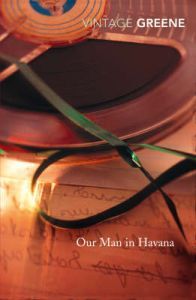
Book Review: Our Man In Havana by Graham Greene

Our Man In Havana
Publisher:  Vintage Classics
ISBN 0099286084

I finished Our Man In Havana last week, but have been waiting to post the review until after our Book Club meeting, in case our discussion makes me think of the book in a different way.

Short synopsis:  Jim Wormold is a British national living in Cuba in the 1950's.  He's a struggling vacuum salesman with an expensive daughter and finds himself in over his head working as a spy for the British, falsifying sub-agents and security reports so that he can claim the wages/expenses.

I've heard a lot of good things about Graham Greene as an author in recent months, and was looking forward to getting into the book.  My initial impression was that it was OK, not bad at all, but not great either.  I felt it was a little slow until the end when the pace suddenly picked up. I wasn't keen on the characters, though I did like the friendship between Wormold and Mr H. I've seen reviews where people have liked the book but didn't like the ending, but at first I felt totally the opposite. I was pretty ambivalent to most of the book but enjoyed the culmination of events in Cuba.

Now that I've had time to discuss and reflect I would like to change my opinion. When viewed as a farce, and a dig at the British Intelligence community it is good. As an observer to the events you are able to see the slow build towards catastrophe, and ridiculousness of the entire situation makes it all quite entertaining.

I may not have loved the style of writing, and the characters each really got on my nerves, and now agree that the last few pages are a touch disappointing, but having said all that it's a pretty good read. I don't think it really lived up to my expectations, and the book didn't make it onto my favourites list, but it's not in the abandoned forever pile either.

The lovely Helen at Fennell Books will probably be writing her own review shortly, so pop over there to see if/how her opinion differs.  I'll be watching for it too, as she wasn't able to attend the club.

Wednesday, March 6, 2013

Animal Farm by George Orwell

Published by:  Penguin Modern Classics
ISBN: 014118270

This is one of those books that makes me feel like I should be writing a terribly impressive academic style review.  That's probably part of the reason why this book only recently made it off my 'should-really-read-one-day' list.  I don't know if I thought it would be over my head, or just that it deserved someone more accustomed to interpreting books in a certain way.

Whatever my reasons for delaying, it got chosen in January for March's book club, and that was that. I bought my copy a couple of weeks ago, and was expecting to suffer through it for the sake of the club.  Ha!

I had some basic recollections of Russian history from courses I studied years ago, so it wasn't a big stretch.  I was expecting something completely different though.  I thought that Orwell would be only making slight references and implying loose correlations between the events on the farm and the events in Russia, but how wrong can you be? 

It was clearly written, easy to read, and there was no mistaking what was happening, the main characters and who they were meant to portray and how key events in Russia's history happened. The purges, and the 5 year plans came to mind immediately.  I love that Orwell refused to pull his punches, and that a publisher was brave enough to publish it.  What a loss this would have been if it had not been published.

The about-face I've taken on this has pretty much given me whiplash. I went from thinking this is a book I should read but don't really want to, to thinking that this is a book that everybody must read.

To refresh my memory I went to Wikipedia and found some articles. I can't speak for the accurateness of them, but they were less of a dry read than the introduction in this book. Here are a few links:

Five Year Plans - http://en.wikipedia.org/wiki/Five-Year_Plans_for_the_National_Economy_of_the_Soviet_Union
The Purges - http://en.wikipedia.org/wiki/Great_Purge

Friday, August 3, 2012

Breakfast at Tiffany's by Truman Capote


Publisher: Penguin Modern Classics
Price/Format: £8.99, paperback.
Bought from: Mr B's Emporium
ISBN 0141182792

Without doubt this deserves it's status as a modern classic, and I encourage everyone to read it at least once. It is beautifully crafted, and an absolute pleasure to read.  Capote's descriptions of people and places are divine, and the picture becomes so clear in your mind.

Holly Golightly is wonderfully written, multi layered and appealing.  All at the same time I felt sorry for her, angry with her, frustrated, motherly even.  She is at once a child, and a grown woman, tough yet vulnerable, and a calculating gold digger who genuinely cares.

I decided not to try to analyse Holly too deeply. I think you could talk yourself in circles and never reach a firm conclusion, so I will leave that topic alone. What I can tell you is that I finished the book a few days ago, and I'm still pondering it all. Another sign of a brilliant character/story.

Capote's skill in writing such a complex character, and situating her so firmly in her world is made even more astounding when you realise that Breakfast at Tiffany's is barely more than a short story, at a mere 91 pages in this edition.

To bulk out the book this edition has three of Capote's short stories at the end. They get progressively better. The first seems to have no point, it really goes nowhere. The second is better, with an interesting ending, but the third I felt was by far my favourite.

Enjoy.