My new book club had this book assigned for discussion in October, and if this (and the Book Thief) planned for next month is anything to go by, I'm going to enjoy this every bit as much as my last group.
And The Mountains Echoed has been reviewed to death by now, so I won’t go into details on the plot, suffice to say a family is broken apart and through pure chance encounters manages to find its way back together, but not quickly and not without significant impact on all the family members. No real spoilers as I think this is fairly obvious from the start.
I’d not read anything by Hosseini before, extensive hyperbole tends to put me off a book, rather than encourage me. I did some reading about Hosseini, and his writing, and understand that this is not even considered his best work, so I’m now very tempted to move those copies of his earlier works up from where they’d been languishing at the bottom of the TBR pile.
The story scope is expansive. It ranges backwards and forwards over several decades and continents. The style is episodic, with each section having a different narrator, and their own distinct voice. Each narrator goes back to a point that their part in the overall story arc started, even if they didn’t know it, and the story follows through until their part is completed. Gradually the reader puts the pieces together, to form the whole.
All narrators have a piece of the story (except the neighbour-brother who lived in America, which wasn’t clear to me at all). They had a direct impact on events, or were necessary to pass on a message. The trick while reading is to not get distracted and try to remember all the threads so that you can sew it all together in your mind as the book moves on.
I have to admit that I was affected on many levels. The writing is wonderful, the slow drip feed of the story was enough to give the characters, time and place real depth, but still keep me reading. I ached for Pari and her brother, and felt each emotion keenly. As I mentioned before I felt that each character had their own voice, and for those in the Western world in particular, they seemed pretty authentic to me. My knowledge of Afghanistan is limited to news bulletins so I can honestly admit that I don’t know it is like to be a normal person in Afghanistan, which neatly brings me to my second point.
The Book Thief forced me to think about what life was like for ordinary Germans during WW2, and in the same way this forced me to be more aware of life in Afghanistan. To my relief it wasn’t a soapbox for a rant about the war, though the war is not avoided. The impact of the war is made clear. What is not lost in a rant is that this is a story about the intersecting lives of one family and the people they come into contact with over a number of generations. I’m a Sociologist by education, and for me it was utterly fascinating to perceive the change in culture and attitudes over time, and though I do not claim to be an expert in these matters, it seems to me that regardless of geography and religious beliefs we are all essentially the same. The overwhelming impression I now have is that below the so-called civilised surface of society we all have a commonality of existence. We all go through the same range of emotions, we all face life and death, have friendships and fall in love.
And yes, I did have a tear or two in my eyes while reading this. If this is regarded by many as not his best work, then I do really need to read the rest. I think this is really really good.
Biblio Addicted: The state of being enslaved to reading books, where it is psychologically or physically habit-forming, to such an extent that its cessation causes severe trauma.
Showing posts with label Book Club. Show all posts
Monday, November 10, 2014
Tuesday, October 28, 2014
Book Club - A Free Read month
My new book club was due to read The Book Thief this month for discussion in early November, but
following the mishaps of the last meeting where the book was not distributed to group members from our local library it was decided that The Book Thief would be delayed til
next month for discussion in December. Instead this month would be a ‘Free Read’. That is to say we read whatever we want and
then talk about our chosen books with the group when we meet.Unfortunately I can't make it to the next meeting and I'm quite disappointed. I was looking forward to talking about the books I've been reading, Not to mention as well that although I have been a member of the book club for three months, I have yet to actually attend a club meeting!
The concept of a free reading month for a book club had never occurred to me, but on reflection seems quite obvious. I think it’s
going to be a really interesting month, and I'm quite upset to not be able to go. Though it is the WI book group, I think based on their list of selections so far they’re not just reading Catherine
Cookson and Maeve Binchy.
Here's what I was going to talk about as my October reading (and why)...
The Darling Buds of May by HE Bates
The Name of the Wind by Patrick Rothfuss
Down The Rabbit Hole by Juan Pablo Villalobos
The astute among you who have also read my recent posts, will realise that at least two of these were read a little while ago. Sneaky I know, but what I hoped to understand by this little bit of canny maneuvering was how far I can push the boundaries when selecting books. Would they be open to a little experimentation in reading? The latter two are both quite controversial, and both absolutely excellent!
Maybe another time.
Saturday, October 4, 2014
Book Club Option 1: A retrospective
On Thursday I had my first taste of the new book club. I raced around at home making dinner, and doing a little more to prepare for my imminent housewarming party. Why is there just never enough time in the evenings?
The book club was due to start at 7:30, but at that time I was finishing a slightly undercooked dinner, and I got to the meeting at about 7:40. There were only two others present (A and S).
My Kindle tells me that I had read about 85% of the book, but S had only got 50% of the way through, and didn't want to hear any spoilers. Which neatly put paid to any discussion between the three of us. Ranty-moment warning: It may just be my opinion but if you turn up to a book club having not finished the book you should not prevent others from talking about it. That is after all the point of a book club, isn't it?
As we'd basically been gagged about 'And the Mountains Echoed' by Khaled Hosseini, I asked about previous books they'd read and we chatted for a bit before giving up waiting for anyone else at about 8pm. Neither A or S were responsible for bringing copies of the next book from the library, so we didn't even know which book was assigned.
So unfortunately book club was a bit of a bust, after all that anticipation. Sad face.
Lurking in my inbox this morning was an email advising that the next book is The Book Thief. One of my favourite books of all time. So I might give it one more month.
The book club was due to start at 7:30, but at that time I was finishing a slightly undercooked dinner, and I got to the meeting at about 7:40. There were only two others present (A and S).
My Kindle tells me that I had read about 85% of the book, but S had only got 50% of the way through, and didn't want to hear any spoilers. Which neatly put paid to any discussion between the three of us. Ranty-moment warning: It may just be my opinion but if you turn up to a book club having not finished the book you should not prevent others from talking about it. That is after all the point of a book club, isn't it?
As we'd basically been gagged about 'And the Mountains Echoed' by Khaled Hosseini, I asked about previous books they'd read and we chatted for a bit before giving up waiting for anyone else at about 8pm. Neither A or S were responsible for bringing copies of the next book from the library, so we didn't even know which book was assigned.
So unfortunately book club was a bit of a bust, after all that anticipation. Sad face.
Lurking in my inbox this morning was an email advising that the next book is The Book Thief. One of my favourite books of all time. So I might give it one more month.
Wednesday, October 1, 2014
Where in the literary world are you today?
Today I am Pari, a young Afghan woman living in Paris. My mother died recently, my father some years ago. I have always had a feeling that something is missing in my life, but have no idea what this is.
I have been several people in the past week or so while reading And The Mountains Echoed by Khaled Hosseini.
The first book to be read for my new book club this Thursday.
I have been several people in the past week or so while reading And The Mountains Echoed by Khaled Hosseini.
The first book to be read for my new book club this Thursday.
Tuesday, September 16, 2014
My Book Club Dilemma
Having moved recently I'm no longer an official member of my old book
club (whom I REALLY miss!!), and am now trying to choose between two new clubs here in
Cambridgeshire.
Book Club One meets every first Thursday of the month at 7:30 in a hotel bar a few minutes walk from my house. There are about 7 or 8 members, and they're reading really interesting books. One at least co-ordinates book loans from the local library and another is involved with the Cambridge Literary Festival.
Book Club Two also meets every first Thursday of the month at 7:30, but centrally at a pub in Cambridge. The inaugral meeting is next month, the first book looks really good, and this club is aimed at people who are new to Cambridge, though not too local to home.
Which would you choose?
Book Club One meets every first Thursday of the month at 7:30 in a hotel bar a few minutes walk from my house. There are about 7 or 8 members, and they're reading really interesting books. One at least co-ordinates book loans from the local library and another is involved with the Cambridge Literary Festival.
Book Club Two also meets every first Thursday of the month at 7:30, but centrally at a pub in Cambridge. The inaugral meeting is next month, the first book looks really good, and this club is aimed at people who are new to Cambridge, though not too local to home.
Which would you choose?
Monday, November 11, 2013
Review: The Daylight Gate by Jeanette Winterson
Publisher: Hammer
ISBN: 0099561832
I don’t think I’ve ever been so productive on the blog as I have with
this Challenge…
I recently read this as a book club selected read for
October. Helen from Fennell Books liked
it as did I think everyone else to some degree.
I didn’t hate it, but I’m not a fan either.
Short Synopsis: Based on the first set of well documented court
records of the Pendle/Lancaster Witch Trials of 1612 it follows Alice Nutter
through the recorded events up to, and a little beyond, the end of the court
hearings. There is some artistic licence
is used to add detail and backstory etc…
As I mentioned earlier I didn’t hate it, but I can’t say that
I enjoyed it either. You know how
sometimes there’s nothing really wrong with a book, but it just doesn’t gel
well for you? No particular reason, it
just doesn’t suit? I’m afraid this was
the case for me with The Daylight Gate.
Maybe it was because it was based on true events. I did spend most of the book thinking about
what was real and what was not. Some of
it was clear, other parts were not, so I was rather distracted by that
throughout. Maybe it depends on whether
you think witchcraft is real. I don’t, so much of the book dealing with the
supernatural aspects I found totally unbelievable. I personally didn't care for any of the
characters. I thought that the treatment
of women in general, and Jennet Device in particular while utterly believable, was
also utterly sickening. This is probably
the best part of the story, in terms of getting me invested in what was
happening. The ending was brilliant!
There were some excellent moments, and if you like
historical fiction you might well enjoy this.
According to members of the book club this will be made into
a film by Hammer as well.
Wednesday, November 6, 2013
Review: Nightfall by Isaac Asmiov and Robert Silverberg
November challenge continues apace...
Publisher: Doubleday
Format: Hardback
Source: Library
This was a treasured read from many years ago, so when I managed
to get agreement to put a Sci-Fi book onto the reading list at Book Club this
was the one I had to suggest. It’s
easily accessible to readers new to SF, and is based on Asimov’s 1941 original
short story, one of the best examples of SF ever written.
Short Synopsis: Kalgash
is a planet with 6 suns. It’s stellar
orbit lasts a little over 2000 years and it is never completely in the dark. The story starts with three apparently
separate threads which converge together about half way through the novel. There is a psychologist studying the effects
of a new theme park ride through a dark tunnel; an archaeologist survives a
sandstorm which reveals evidence of multiple
layers of past civilisations and their regular destruction; and a scientist
realises that the standard calculation of the stellar orbit of Kalgash isn’t
quite right. You can probably surmise what
happens when all three threads finally meet.
Though the 1941 short story is highly praised, unfortunately
the version expanded on by Robert Silverberg was not so well received. Asimov’s short story has its major impact in
its brevity, having to be faster paced and punchier. However I think the novel expands in areas I
felt lacking in the shorter version. It’s
not perfect by any means, but I thoroughly enjoyed it. The themes of science vs religion, the
exploration of fear of the unknown and our relative smallness in the universe were
well portrayed and despite its alien world setting, it is highly transferable
to our own society.
The response from the book club was mixed, which can be hard
to take when you love the book that some people just didn’t get. It was well received by some but those that
turned up tended towards mockery of the plot and the science. I suppose we have the benefit of 21st
century knowledge over the original 70+ year old story, and the parts that were
pulled apart were the parts expanded upon by Silverberg. Asimov’s concepts were acknowledged as very
good though, which I suppose is something :-)
I read this for the first time not long after publication of
the extended novel, about 20 years ago, and it endured with me for one
particular scene. The scene describes
the astronomer Beenay handing out cameras to his team instructing them to
photograph the stars. He instructs them
not to waste time trying to get more than a few stars in each photo. Of course when the darkness finally comes the
sheer number of stars is overwhelming, and the ridiculous notion of there only
being a handful of stars is realised.
I was lucky enough once to be in the Australian outback at
night, and though I had seen photos of a full-on starry sky, it still didn’t
prepare me for the spectacle that is the Milky Way. It brought back the memory of that moment in
the book where they begin to realise the magnitude of the universe. Now every time I look at a starry sky that
moment pops into my head. I imagine that
will be with me for the rest of my days.
So, Nightfall has it’s pitfalls, but it’s still
an entertaining read overall. I would
certainly read the short story version at least! It is available on the internet and I think
you can download it free of charge from a number of sources.
Saturday, April 27, 2013
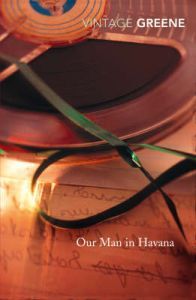
Book Review: Our Man In Havana by Graham Greene

ISBN 0099286084
I finished Our Man In Havana last week, but have been waiting to post the review until after our Book Club meeting, in case our discussion makes me think of the book in a different way.
Short synopsis: Jim Wormold is a British national living in Cuba in the 1950's. He's a struggling vacuum salesman with an expensive daughter and finds himself in over his head working as a spy for the British, falsifying sub-agents and security reports so that he can claim the wages/expenses.
I've heard a lot of good things about Graham Greene as an author in recent months, and was looking forward to getting into the book. My initial impression was that it was OK, not bad at all, but not great either. I felt it was a little slow until the end when the pace suddenly picked up. I wasn't keen on the characters, though I did like the friendship between Wormold and Mr H. I've seen reviews where people have liked the book but didn't like the ending, but at first I felt totally the opposite. I was pretty ambivalent to most of the book but enjoyed the culmination of events in Cuba.
Now that I've had time to discuss and reflect I would like to change my opinion. When viewed as a farce, and a dig at the British Intelligence community it is good. As an observer to the events you are able to see the slow build towards catastrophe, and ridiculousness of the entire situation makes it all quite entertaining.
I may not have loved the style of writing, and the characters each really got on my nerves, and now agree that the last few pages are a touch disappointing, but having said all that it's a pretty good read. I don't think it really lived up to my expectations, and the book didn't make it onto my favourites list, but it's not in the abandoned forever pile either.
The lovely Helen at Fennell Books will probably be writing her own review shortly, so pop over there to see if/how her opinion differs. I'll be watching for it too, as she wasn't able to attend the club.
Saturday, April 20, 2013
The Hundred-Year-Old Man Who Climbed Out of the Window and Disappeared by Jonas Jonasson
ISBN: 1843913720
In a word - Hilarious!
If you read my review of Advent you'll know that it suffered from a reading break half way through. The same thing happened with this story, but unlike Advent picking up the story again was seamless.
The story centres around Alan Karlsson who is about to celebrate his 100th birthday, but he'd rather avoid the whole thing and so decides to escape the nursing home by means of the window and shuffle away in his slippers. He encounters some criminals and makes new friends along the way, all the time pursued by the Police. Interspersed with this present day storyline is the history of Alan's long and remarkable life.
Somehow, though a series of highly improbable events Alan unwittingly involves himself in many of the major events of the 20th century. It's a brilliantly inventive way to examine our recent past, though Alan is fictional of course, the dates, times and characters are I believe otherwise accurate.
It is pretty much a farce from start to finish, and I have not laughed at a book so much in ages. You do have to read this in that light, if you tried to take it seriously I think you'd really struggle with this one.
What I liked most: Anticipating the next thing Alan was about to do, the surprise when things turn out differently (but better-funnier). Vladivostock just got funnier and funnier. Herbert Einstein.
What I liked least: drawing a lot of attention to myself in the restaurant at work laughing about Vladivostock.
Wednesday, March 6, 2013
Animal Farm by George Orwell
Published by: Penguin Modern Classics
ISBN: 014118270
This is one of those books that makes me feel like I should be writing a terribly impressive academic style review. That's probably part of the reason why this book only recently made it off my 'should-really-read-one-day' list. I don't know if I thought it would be over my head, or just that it deserved someone more accustomed to interpreting books in a certain way.
Whatever my reasons for delaying, it got chosen in January for March's book club, and that was that. I bought my copy a couple of weeks ago, and was expecting to suffer through it for the sake of the club. Ha!
I had some basic recollections of Russian history from courses I studied years ago, so it wasn't a big stretch. I was expecting something completely different though. I thought that Orwell would be only making slight references and implying loose correlations between the events on the farm and the events in Russia, but how wrong can you be?
It was clearly written, easy to read, and there was no mistaking what was happening, the main characters and who they were meant to portray and how key events in Russia's history happened. The purges, and the 5 year plans came to mind immediately. I love that Orwell refused to pull his punches, and that a publisher was brave enough to publish it. What a loss this would have been if it had not been published.
The Purges - http://en.wikipedia.org/wiki/Great_Purge
ISBN: 014118270
This is one of those books that makes me feel like I should be writing a terribly impressive academic style review. That's probably part of the reason why this book only recently made it off my 'should-really-read-one-day' list. I don't know if I thought it would be over my head, or just that it deserved someone more accustomed to interpreting books in a certain way.
Whatever my reasons for delaying, it got chosen in January for March's book club, and that was that. I bought my copy a couple of weeks ago, and was expecting to suffer through it for the sake of the club. Ha!
I had some basic recollections of Russian history from courses I studied years ago, so it wasn't a big stretch. I was expecting something completely different though. I thought that Orwell would be only making slight references and implying loose correlations between the events on the farm and the events in Russia, but how wrong can you be?
It was clearly written, easy to read, and there was no mistaking what was happening, the main characters and who they were meant to portray and how key events in Russia's history happened. The purges, and the 5 year plans came to mind immediately. I love that Orwell refused to pull his punches, and that a publisher was brave enough to publish it. What a loss this would have been if it had not been published.
The about-face I've taken on this has pretty much given me whiplash. I went from thinking this is a book I should read but don't really want to, to thinking that this is a book that everybody must read.
To refresh my memory I went to Wikipedia and found some articles. I can't speak for the accurateness of them, but they were less of a dry read than the introduction in this book. Here are a few links:
Animal Farm - http://en.wikipedia.org/wiki/Animal_Farm
Five Year Plans - http://en.wikipedia.org/wiki/Five-Year_Plans_for_the_National_Economy_of_the_Soviet_Union The Purges - http://en.wikipedia.org/wiki/Great_Purge
Friday, February 22, 2013
Book Club Meeting
I'm sure I shant be blogging about every book club, but this was an interesting one.
The location - The largest (only?) inhabited roundabout in the UK. The Shepherd and Flock pub in Farnham, Surrey. Though half the group must have driven past it many times they didn't know it was there, apparently they drove a complete circuit around the roundabout once before realising how to get on it. So was the Fire Engine that nearly drove through the side of the pub trying to turn around in a space not much bigger than itself. It reminded me of my favourite scene in the first Austin Powers film... http://www.youtube.com/watch?v=iLKR9tCiwvA
A Dark-Adapted Eye had been reasonably well received. There was a lot of puzzled discussion, and even talk of whether or not Vera was Eden's mother (I thought not, but who knows). We all hated Francis. I'd prepared some discussion questions, but totally forgot to take them.
Next months book is Animal Farm by George Orwell. That's rather a small volume, and what I've read so far it's an easy read, though I may have to read a little more around the Russian Revolution to make sure I get all the references. Maybe even get something like the York Notes or other study guide for Animal Farm.
As Animal Farm is such a short book we decided to read something a little longer next time, and chose for April's meeting The Hundred Year Old Man Who Climbed Out of the Window and Disappeared by Jonas Jonasson. Having already started it I don't think that will take long to read. It's a much bigger book than Animal Farm, but it's so entertaining and funny I think that will only take a few days to get through.
So I have put it to one side and will read after Animal Farm. But as I can't just read one book at a time )I have a book for bathtime, a book in the desk drawer at work, a book (well, a stack and a shelf actually) in my bedroom and one in my bag, I have picked up Advent by James Treadwell. This was one of my Christmas presents. The first few pages look very promising. I'll have to make it my next First Paragraph's post.
The location - The largest (only?) inhabited roundabout in the UK. The Shepherd and Flock pub in Farnham, Surrey. Though half the group must have driven past it many times they didn't know it was there, apparently they drove a complete circuit around the roundabout once before realising how to get on it. So was the Fire Engine that nearly drove through the side of the pub trying to turn around in a space not much bigger than itself. It reminded me of my favourite scene in the first Austin Powers film... http://www.youtube.com/watch?v=iLKR9tCiwvA
A Dark-Adapted Eye had been reasonably well received. There was a lot of puzzled discussion, and even talk of whether or not Vera was Eden's mother (I thought not, but who knows). We all hated Francis. I'd prepared some discussion questions, but totally forgot to take them.
Next months book is Animal Farm by George Orwell. That's rather a small volume, and what I've read so far it's an easy read, though I may have to read a little more around the Russian Revolution to make sure I get all the references. Maybe even get something like the York Notes or other study guide for Animal Farm.
As Animal Farm is such a short book we decided to read something a little longer next time, and chose for April's meeting The Hundred Year Old Man Who Climbed Out of the Window and Disappeared by Jonas Jonasson. Having already started it I don't think that will take long to read. It's a much bigger book than Animal Farm, but it's so entertaining and funny I think that will only take a few days to get through.
So I have put it to one side and will read after Animal Farm. But as I can't just read one book at a time )I have a book for bathtime, a book in the desk drawer at work, a book (well, a stack and a shelf actually) in my bedroom and one in my bag, I have picked up Advent by James Treadwell. This was one of my Christmas presents. The first few pages look very promising. I'll have to make it my next First Paragraph's post.
Wednesday, February 20, 2013
A Dark-Adapted Eye by Barbara Vine
Publisher - The edition I read had previously been published free with Country Living magazine, and was bought from Green Metropolis for £3.75. It's widely available through Green Metropolis, ebay and Amazon to name but a few.
Barbara Vine is Ruth Rendell, and A Dark-Adapted Eye was assigned as February's book club book. The title refers to how the narrator recalls events from earlier decades and slowly the picture becomes clearer the more she remembers, much like you might observe in a dark room, as your eye adapts to the dark you are able to see more.
We have our book club meeting tomorrow night, and I finished the story this morning. I must admit I speed-read through the last 50-100 or so pages, partly because I was afraid I wouldn't finish it in time, and partly because I'd read that there were twists at the end that it was worth reading for.
Part of me was expecting the twist to be that Vera was not guilty, even though it's clearly stated from the start that she was guilty and there had been several witnesses. It's not so much a whodunit as a whydidshedoit.
Every review was glowing, and while I can see that technically it's very good, extremely well crafted and keeps you guessing til the end (and beyond), I can't say that I enjoyed it. I don't think it's a book that you 'enjoy'. I think it's meant to puzzle you, and intrigue you, and make you want to keep reading to find out why Vera was hanged, what could have gone so wrong for a woman who so strictly lived to a decent moral code. I didn't get that feeling either. I wasn't thinking about it when I wasn't reading it, I could easily have put it down and not picked it up for a week, and if something had happened to the book and I lost it, I would not have bought/borrowed another copy to find out what happened.
What was brilliant about it was the teasing and slow drip-feed of information, and realising how your perception of characters and events changes over the time. For instance I interpreted the opening paragraphs as though the narrator is planning a murder. It soon became clear what was really going on, but you need to read the whole story to understand the whys and wherefores. I pretty much detested Vera and Eden at the beginning, but by the end I was desperately sorry for them both.
Occasionally I watch the soaps, and when we discuss what's happening in the storyline it can feel like we're discussing it as though it were real. That's kind of how I feel when I think about this. I feel quite sad when I think of all the times that the narrator, Faith, points out how things could have worked out differently. I have to remind myself that it's not real.
Would I recommend it? Yes, despite everything I've said above I would recommend it.
Questions I want to raise tonight... (I've left one or two out as they're spoilers in themselves, but if you read the book you'll be asking those questions yourself).
Barbara Vine is Ruth Rendell, and A Dark-Adapted Eye was assigned as February's book club book. The title refers to how the narrator recalls events from earlier decades and slowly the picture becomes clearer the more she remembers, much like you might observe in a dark room, as your eye adapts to the dark you are able to see more.
We have our book club meeting tomorrow night, and I finished the story this morning. I must admit I speed-read through the last 50-100 or so pages, partly because I was afraid I wouldn't finish it in time, and partly because I'd read that there were twists at the end that it was worth reading for.
Part of me was expecting the twist to be that Vera was not guilty, even though it's clearly stated from the start that she was guilty and there had been several witnesses. It's not so much a whodunit as a whydidshedoit.
Every review was glowing, and while I can see that technically it's very good, extremely well crafted and keeps you guessing til the end (and beyond), I can't say that I enjoyed it. I don't think it's a book that you 'enjoy'. I think it's meant to puzzle you, and intrigue you, and make you want to keep reading to find out why Vera was hanged, what could have gone so wrong for a woman who so strictly lived to a decent moral code. I didn't get that feeling either. I wasn't thinking about it when I wasn't reading it, I could easily have put it down and not picked it up for a week, and if something had happened to the book and I lost it, I would not have bought/borrowed another copy to find out what happened.
What was brilliant about it was the teasing and slow drip-feed of information, and realising how your perception of characters and events changes over the time. For instance I interpreted the opening paragraphs as though the narrator is planning a murder. It soon became clear what was really going on, but you need to read the whole story to understand the whys and wherefores. I pretty much detested Vera and Eden at the beginning, but by the end I was desperately sorry for them both.
Occasionally I watch the soaps, and when we discuss what's happening in the storyline it can feel like we're discussing it as though it were real. That's kind of how I feel when I think about this. I feel quite sad when I think of all the times that the narrator, Faith, points out how things could have worked out differently. I have to remind myself that it's not real.
Would I recommend it? Yes, despite everything I've said above I would recommend it.
Questions I want to raise tonight... (I've left one or two out as they're spoilers in themselves, but if you read the book you'll be asking those questions yourself).
How could things have been different?
Is anyone who they seem at first?
What about Francis?
Can you trust Faith? Were Vera and Eden as bad as she remembers, especially her earlier memories?
What was Daniel Stewarts aim in writing Vera’s story?
Would you re-read this?
Friday, November 23, 2012
Dark Matter: A Ghost Story by Michelle Paver
Bought from: Mr B's Emporium
ISBN 1409121186
This was one of the first books I read from Mr B's Reading Spa recommendations. I am well known in my circle of friends and family to be a downright scaredy cat, and have nightmares for weeks after watching or reading something particularly scary, so I was a little aprehensive about reading this.
I had decided that having read it back in July/August it was too late to post a review about it now, but what do you know? Apparently sometime after reading it I posted about it on our facebook book club page and it's now assigned as one of our upcoming books. I may give it another go, knowing what happens may add a certain something to re-reading it. Kind of like re-watching a film and seeing all the clues you missed the first time.
Set in the 1930's Jack is a poor man with a bit of a chip on his shoulder, who gets given a great opportunity to do something incredible and take part in a scientific expedition to overwinter in the arctic circle. His team members bit by bit leave him for various reasons and he finds himself left to carry the expedition on his own, accompanied only by the sled dogs and the feeling of not being really alone in the permanent darkness.
For much of the novel you aren't sure if Jack is actually being haunted or just mentally crumbling under the strain of being alone in the constant darkness of such a stark environment. It is essentially up to you to decide which you want to believe, and neither are comfortable options.
I thoroughly enjoyed the story, up to about half way through I was quite happy to read at night, but as the story progresses the tension mounts and I had to finish the book while only reading during the day. It was well written I thought, easy to read, well paced with events escalating throughout the story. The descriptions of the place, Jack, etc are all wonderful and really bring the story to life.
If you're braver than me (lets face it - who isn't?) then I highly recommend reading it at night. If we have another cold snowy winter it would really be an excellent atmospheric read. I am particularly looking forward to re-reading it while I'm cosy and warm on a wintry night in deepest darkest December.
Friday, November 2, 2012
Collected Ghost Stories by M.R. James
Edited by Darryl Jones
Publisher: Oxford University Press
Price/Format: £10.49, hardback.
Bought from: Amazon
ISBN 0199568847
In a previous review I discussed my feelings of the short story format, and my feelings have not changed, though for this collection it is a good thing. I was quite happy for the stories to be short and to be able to take a break between them.
For our October book club book we decided to read something spooky for Halloween, and after much deliberation I suggested MR James, as one of the earliest writers of the genre, and because as a teenager he'd scared me silly.
I'm *ahem* older now, and a little desensitised to the genre, but there is still something spine tingling about this collection. The writing is naturally dated, and overly concerned with class and British stiff-upper-lip and it's also rather formulaic. It's obviously a case of MR James writing what he knew (libraries, old books and documents, abbeys etc etc) and much is laughable in this day and age. But there's a creepiness that plays on the mind... things that move in the corner of your eye, strange voices, shadows... all those edge-of-consciousness things that unsettle you, and it actually works very well.
This edition is particularly packed full, not only of (I think) every short story he published, but also various writings from James on the nature of ghost stories. Reading these he explains he only wanted to write the type of stories I have described above, the ones that linger in the subconscious and make the reader feel unsettled. For him these were never meant to be gorefests or to frighten you half to death, they were only meant to generate that shivers-down-your-spine feeling. And in my opinion he succeeds brilliantly.
I read a couple at night, and then resigned myself to only reading during the day. I won't say which I have read as yet, and which I have not, or try to tell you what is good or not so good. That's not for me to decide for you. My advice for this collection is to smile and accept the settings and plot decisions for what they are, and just enjoy each story as it comes.
If you like to be a little more creeped out try reading at night, or even by candlelight for the uber-spooky effect, as one of our book club members did.
Publisher: Oxford University Press
Price/Format: £10.49, hardback.
Bought from: Amazon
ISBN 0199568847
In a previous review I discussed my feelings of the short story format, and my feelings have not changed, though for this collection it is a good thing. I was quite happy for the stories to be short and to be able to take a break between them.
For our October book club book we decided to read something spooky for Halloween, and after much deliberation I suggested MR James, as one of the earliest writers of the genre, and because as a teenager he'd scared me silly.
I'm *ahem* older now, and a little desensitised to the genre, but there is still something spine tingling about this collection. The writing is naturally dated, and overly concerned with class and British stiff-upper-lip and it's also rather formulaic. It's obviously a case of MR James writing what he knew (libraries, old books and documents, abbeys etc etc) and much is laughable in this day and age. But there's a creepiness that plays on the mind... things that move in the corner of your eye, strange voices, shadows... all those edge-of-consciousness things that unsettle you, and it actually works very well.
This edition is particularly packed full, not only of (I think) every short story he published, but also various writings from James on the nature of ghost stories. Reading these he explains he only wanted to write the type of stories I have described above, the ones that linger in the subconscious and make the reader feel unsettled. For him these were never meant to be gorefests or to frighten you half to death, they were only meant to generate that shivers-down-your-spine feeling. And in my opinion he succeeds brilliantly.
I read a couple at night, and then resigned myself to only reading during the day. I won't say which I have read as yet, and which I have not, or try to tell you what is good or not so good. That's not for me to decide for you. My advice for this collection is to smile and accept the settings and plot decisions for what they are, and just enjoy each story as it comes.
If you like to be a little more creeped out try reading at night, or even by candlelight for the uber-spooky effect, as one of our book club members did.
Subscribe to:
Posts (Atom)